Leather, Synthetic or Hybrid: What a Ball Cover Is Designed to Do
Compare ball cover materials by touch, texture, intended surface and care so you can choose a ball suited to your sport and the conditions where you play.
Which ball cover material suits the way you play? Leather, synthetic and hybrid ball cover materials are designed to balance touch, grip, durability and weather response differently. The right choice depends on the sport, playing surface and conditions—not on one material being best for every game.
Start with the sport
A cover is the ball’s outer playing surface, but it works alongside the bladder, panel construction, seams and texture. The same material can feel different on a basketball, soccer ball or tennis ball because each is built for distinct handling and impact.
Begin with the ball’s intended sport and level of play. A soccer ball is expected to travel and respond to the foot; a basketball meets the hand repeatedly with a predictable bounce; a tennis ball’s felt cover shapes its contact with the racket and court. Compare cover materials within those demands, rather than across unrelated sports.
Then consider where the ball will be used. Indoor floors, outdoor courts, grass and rough shared spaces place different demands on a surface. Choose a ball labeled for the intended sport and setting before weighing material preferences.
Leather and touch
Leather covers are associated with a supple, close-contact feel. In sports where players control the ball with their hands or feet, that response may suit someone who values natural-feeling touch and is willing to follow the care instructions.
Leather is not a promise of a particular softness or quality. Treatment, construction and intended use all matter. A leather ball may not suit damp conditions or rough outdoor play, so check its stated use rather than relying on the material name.
Choose leather when touch is a priority and the ball’s label matches the playing environment. Store it clean and dry according to the manufacturer’s guidance.
Synthetic and versatility
Synthetic covers use manufactured materials, often with a textured or coated surface. Some are designed for varied settings, including outdoor use, and may be straightforward to wipe clean. That does not make every synthetic ball equally weather-ready or durable; the product’s stated use still matters.
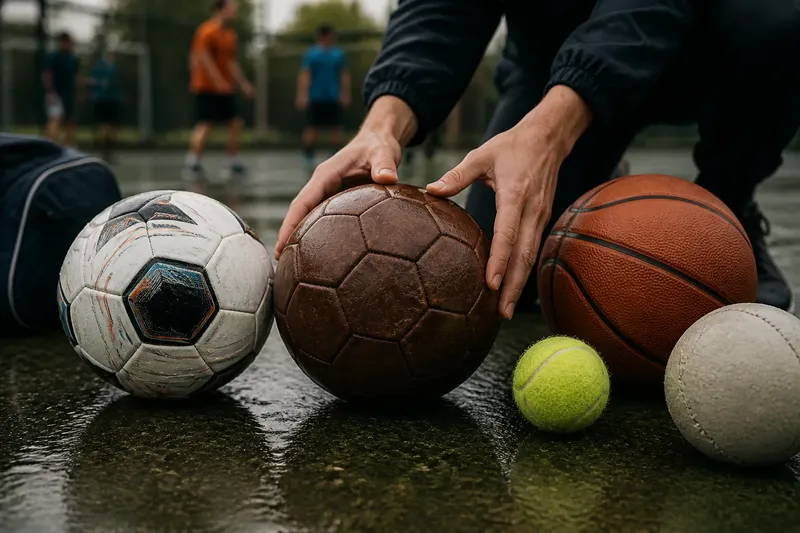
Texture changes the feel as much as the broad material category. A pebbled basketball cover, a smooth-coated soccer ball and a felted tennis ball create distinct kinds of contact. If possible, handle the specific model instead of relying on the word “synthetic.”
For a ball shared across casual sessions, or used where convenient cleaning matters, a synthetic cover may fit if the label supports that use.
Hybrid construction
Hybrid covers combine materials or construction features to pursue a particular balance—for example, a softer contact surface with a more resilient backing, or panels joined in a way intended to affect touch and water uptake. The term describes an approach, not a standard recipe.
Product details are especially useful here. Check the sport, recommended surface and care information, then judge the ball by its intended role. A hybrid design may appeal if you want a particular feel without choosing a purely natural or synthetic cover, but the name alone does not reveal how it will play.
Say a community club is choosing between two soccer balls for mixed outdoor sessions. One is a leather model intended for controlled conditions; the other is a synthetic hybrid labeled for the club’s usual surface. The club selects the hybrid for those sessions, expecting routine cleaning to be straightforward and the cover to suit that setting. Players can still differ in which ball feels better.
Match cover to use
Use these observations to decide what to compare next:
- Touch-led practice: If players value close-contact feel and the ball is labeled for the sport and setting, consider leather; if conditions are damp or rough, choose a model specifically suited to them instead.
- Outdoor sessions: If the label names the relevant outdoor surface, consider that synthetic model; if it does not, compare a ball explicitly intended for the surface.
- Mixed construction: If a hybrid model’s description specifies the desired feel and playing surface, compare it with other models on those details; if it does not, do not assume the category predicts its behavior.
- Wet or changing conditions: If the manufacturer states that the ball is suitable for those conditions, consider it for that use; if not, select a model with clearer guidance.
- Shared use and cleaning: If the care instructions allow the cleaning routine your group needs, the ball may be a practical fit; if they do not, choose one with compatible care guidance.
- Young or occasional players: If the ball is the correct type for the sport and feels comfortable to handle, it may suit the group; if either condition is missing, compare an appropriate alternative.
For a special playing surface or competition, follow the ball label, manufacturer instructions and applicable local rules.
How do cover materials compare?
Does leather always feel softer?
No. Treatment, texture and construction affect contact, so the material name cannot tell you exactly how a particular ball will feel. Handle the model if possible and check that it suits your intended conditions.
Is synthetic better outdoors?
Some synthetic balls are designed for outdoor play, but the category alone does not establish suitability. Check the model’s intended surface and care details.
What does hybrid mean?
It means a design combines materials or construction features, but hybrid balls do not share one standard feel. Compare each model’s stated purpose and surface details.
How can I judge a cover in person?
Handle the ball if you can, noticing its texture and response to a light touch. Then confirm that its label fits your sport and playing conditions.
Look beyond the cover
Cover choice is one part of a ball’s character, not a shortcut to predicting every aspect of play. Panel layout, surface texture and construction shape contact, while the intended sport determines what those design choices are meant to serve.
When comparing ball cover materials, read the product description for specific uses, then consider who will handle the ball and where it will be played. If two models fit the setting, their texture and care instructions can help narrow the choice. Keep the label or care guidance available after purchase so the ball remains matched to the sessions you use it for.