Why a Football Pitch Has So Many Marked Areas
Football pitch markings clarify boundaries, restarts and penalty decisions, helping spectators understand what each line means and what happens next.
When a ball skims the touchline or a referee points to the penalty mark, which line decides what happens next? Football pitch markings give players and officials shared reference points for boundaries, restarts and decisions in specific areas. Their meaning becomes clearer when you connect each marking to an action.
Football pitch markings
The outer boundary consists of two touchlines along the long sides and two goal lines at the ends. The ball is out of play when it has wholly crossed a boundary line, on the ground or in the air. Since the line belongs to the area it encloses, a ball touching the line has not wholly crossed it.
When the ball goes out over a touchline, the restart is a throw-in for the opponents of the player who touched it last. At the goal line, the restart depends on who touched the ball last and whether a goal was scored: play may resume with a goal kick, a corner kick or a kick-off after a goal.
Each goal is centered on a goal line. A goal is scored when the whole ball crosses the goal line between the posts and beneath the crossbar, provided no infringement prevents it from counting.
The penalty area
The larger rectangle in front of each goal is the penalty area. The goalkeeper’s special permission to handle the ball applies within their own penalty area, subject to restrictions in the Laws of the Game. The area also matters when the defending team commits an offense punishable by a direct free kick there: the referee may award a penalty kick.
The penalty mark sits inside the area, centered in front of the goal. A penalty kick follows certain offenses by the defending team in its own penalty area; not every infringement there has the same consequence. The penalty arc outside the area helps show the required distance from the mark for players other than the kicker and goalkeeper.
Imagine a defender commits a direct-free-kick offense just inside the penalty-area line. The referee judges that a foul occurred and awards a penalty kick; the line counts as part of the area, while the nearby arc does not change the location of the offense.
The goal area
The smaller rectangle inside the penalty area is the goal area, often called the six-yard box. For a goal kick, the ball is placed within this area and must be stationary. It also affects the location of certain indirect free kicks awarded to the attacking team for offenses inside it.
The goal area is not a smaller penalty area. The larger rectangle identifies the area relevant to goalkeeper handling and penalty-kick decisions; the smaller one supplies specific restart locations. For a goal kick, the ball may be placed anywhere within the goal area, rather than only at its center.
At a goal kick, look for the ball’s placement, not just where the goalkeeper stands.
Circles and corner arcs
The center mark indicates where the kick-off is taken, and the center circle marks the distance opposing players must keep from the ball until it is in play. The circle does not affect ordinary play after the kick-off.
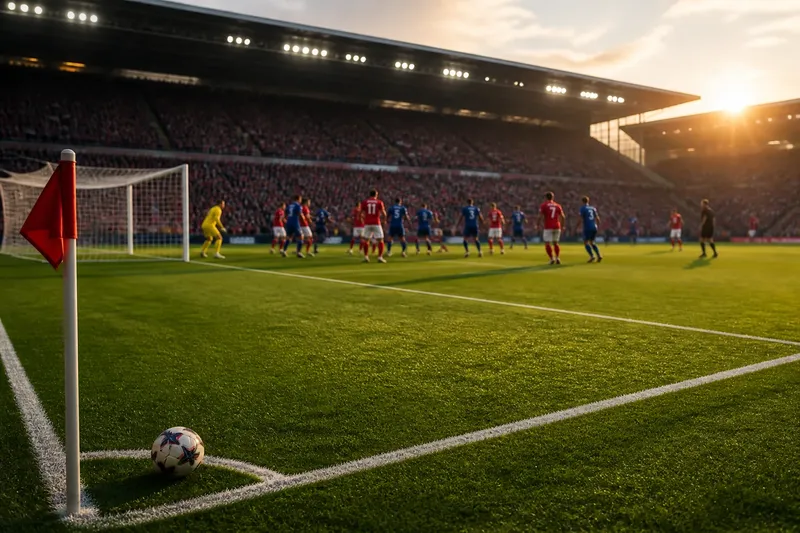
At each corner, the corner arc marks the area where the ball is placed for a corner kick. Opponents must remain the required distance away under the applicable Laws. A corner is awarded when the defending team touched the ball last before it wholly crossed its goal line without a goal being scored.
A corner flag marks the corner, but it is not itself a boundary line. The goal line and touchline determine whether the ball has gone out; the arc helps locate the restart.
Penalty-area questions?
Does the penalty-area line count as inside?
Yes. The boundary line forms part of the area it encloses, so a qualifying direct-free-kick offense on that line is treated as occurring inside the penalty area. The referee must still judge whether an offense took place and what restart applies.
Can a goalkeeper handle the ball anywhere in the box?
The special permission to handle the ball applies within the goalkeeper’s own penalty area, not only within the goal area. Restrictions still apply, including those concerning a deliberate kick from a teammate or a throw-in from a teammate.
What does the penalty arc mean?
The arc shows the distance from the penalty mark that players other than the kicker and goalkeeper must observe during a penalty kick. It is associated with the penalty mark but does not extend the penalty area. The applicable Laws and competition regulations govern player positioning and when players may enter the area.
Does the goal area set every free-kick location?
No. It affects goal-kick placement and certain indirect free kicks awarded to the attacking team for an offense inside the goal area. Other free kicks are generally taken from the place of the offense, subject to the applicable restart rules.
Lines in context
Each marking answers a different question. The outer lines show whether the ball has left the field; the penalty area frames goalkeeper handling and penalty-kick decisions; the goal area identifies particular restart locations; and the center circle and corner arcs help organize positions and distances.
Say you are watching a match and the ball rolls over the goal line after an attacker touched it last. You note that the whole ball crossed and that the defending team was the last to touch it before the attacker. Since no goal was scored, the restart is a goal kick; the goal-area marking then shows where the ball may be placed. If instead a defender had touched it last, a corner kick would follow.
For a formal match, consult the Laws of the Game and the competition’s regulations, since particular restart details and permitted field arrangements can depend on the rules in force. For a spectator, the useful habit is simpler: identify which line is involved, establish who touched the ball last when relevant, and then watch for the referee’s signal. Football pitch markings provide the map, while the incident and applicable rules determine the decision.