Your First Track Meet: Follow One Race at a Time
Your first track meet is easier to follow when you choose one race, learn its start and stages, and watch how the finish takes shape.
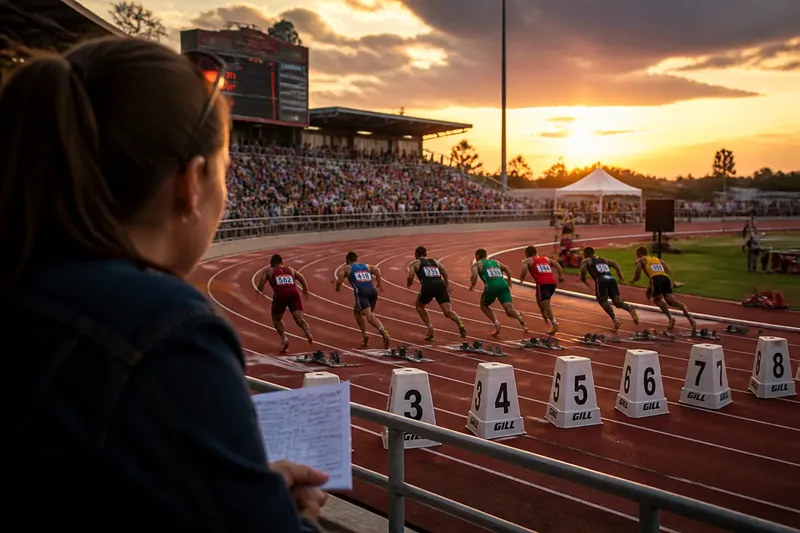
Which race should you watch first at your first track meet? Choose one event on the program, find out where it starts and finishes, then give it your attention from the call to the line. A track meet can send runners in several directions at once, but you do not need to understand every event to follow one well. A single race gives you a clear thread: preparation, movement, decisions, and a result.
Choose Your Race
Before the meet begins, look at the printed program or the schedule posted at the venue. Find an event that interests you and note its event name, scheduled time, and any heat or round information. The schedule may change as earlier events run long, so treat the listed time as a guide rather than a precise start.
For a first visit, a short race is easy to locate and follow because the start and finish are close together in time. A longer race offers more room to notice changes in pace and position. Neither is the right choice for everyone: pick the event whose shape makes you curious. If you choose a relay, expect baton exchanges to be part of the story; if you choose a hurdle race, watch how runners maintain rhythm between barriers.
Check whether your chosen event is a heat, a final, or another round. Heats sort entrants into groups, and the route onward may depend on the meet’s rules. The program or announcer may explain what follows, but you can still enjoy the race without predicting who advances. Record the event name on a note in your phone or keep the program open to its page.
Pick one event, and let the rest of the schedule wait.
Find the Course
Once you are at the venue, identify the finish line first. It is often marked by a line across the track and a finish-area structure, but the layout varies. Then look for the start associated with your chosen event. A sprint may begin on a staggered line, with some runners positioned farther around the curve so that each lane covers an equal distance. The lanes can make the start look uneven; that is part of the course, not a head start.
Longer races may use a curved start or begin from a line across part of the track. For an event that goes more than one lap, ask an usher or consult the program to learn how laps are counted. A lap counter, bell, or announcer can help, but listen for the wording used at that meet. If you cannot tell which lap is underway, focus on the pack’s spacing and keep watching the runners you selected.
Choose a seat or standing place with a clear view of the start and finish if possible. If the venue is too large for both, favor the section that lets you see the most consequential part of your race. For a sprint, that may be the start or finish; for a longer event, a view along the straight can reveal changes in position. Avoid blocking other spectators, and follow any seating or access instructions from venue staff.
Use the scoreboard, program, and public address announcements as aids, not as substitutes for the race itself. Names may be hard to hear, and event schedules can shift. The most useful information is often simple: which event is assembling, where it starts, and when the runners are ready.
Read the Start
Watch what happens before the gun or starting signal. Officials may call athletes to the start, check that they are in the correct lanes, and ask them to settle into position. Runners may stretch, shake out their arms, or take a brief pause. These small actions do not tell you who will win; they show how each athlete arrives at the same moment of concentration.
Listen for the starter’s commands. In a sprint, athletes may crouch in starting blocks. In other races, they may stand. The exact procedure varies with the event and competition rules, so follow the officials’ directions and the signals you can hear. Avoid talking over the start; a quiet few seconds makes it easier to notice the call and see the first movement.
At the signal, watch the first few strides rather than trying to scan every lane. Notice whether the field leaves together, whether one runner accelerates quickly, and how the athletes settle into their lanes. A stagger can make a runner appear ahead while the race is still developing. In a longer event, the initial burst may give way to a more measured pace, so do not assume the first position is the final one.
Say you choose a 400-meter race and see one runner start farther around the curve than the others. Keep that lane in view, but compare the runners again as they approach the straight. The stagger is designed to account for the curved route; the useful observation is how their positions change as they move through the race.
Follow the Stages
For a short sprint, divide your attention into three moments: the launch, the middle of the race, and the finish. At the launch, watch the first strides and how runners establish their rhythm. Through the middle, track whether the field stays close or separates. Near the finish, look for who maintains speed and who gains ground. You do not need to name a technique to see the race’s shape.
In a longer race, follow the group rather than trying to remember every athlete’s position. Notice where the pack is compact and where gaps open. Watch for a runner moving toward the front, drifting behind the main group, or changing pace on a straight. These are observations, not explanations: from the stands, you usually cannot know why an athlete changes position.
For hurdles, follow the sequence of running and clearing barriers. A smooth rhythm can be easier to see than the exact mechanics of each leap. In a relay, watch the outgoing runner and the exchange area as well as the incoming athlete. The baton must be passed within the designated zone; officials oversee the exchange under the meet’s rules. Keep your view on the exchange without stepping into restricted areas.
Try not to divide your attention between every race on the track and field. If another event catches your eye, note it for later, then return to your chosen runners. One race followed closely can make the venue feel less scattered and help you recognize what changes from start to finish.
What Should You Watch?
How do I know when my race is about to start?
Watch the staging area for athletes gathering, officials checking lanes, and competitors being called forward. The announcer or schedule can help confirm the event, but stay nearby because the order may shift.
Why are runners starting at different places?
On a curved track, lanes follow different paths, so staggered starting positions can make the distance equal. The apparent lead at the gun may therefore be misleading; compare positions as the runners progress.
What should I follow in a longer race?
Keep an eye on the main pack and notice when its shape changes. If the event covers multiple laps, listen for a lap indicator or ask an official how the meet marks the remaining distance.
How do I tell who has won?
Watch the runners cross the finish line, then check the scoreboard or wait for the announcer to identify the result. In a close finish, the official result may take a moment to appear.
Read the Finish
As the runners approach the finish, keep your eyes on the line rather than on a scoreboard. The order at the line determines the immediate result, but a close finish may not be obvious from a distant seat. Give officials time to confirm the placing, especially if the display has not updated. A runner slowing after crossing has finished the race; do not mistake that for the moment the result was decided.
Notice how the athletes carry themselves through the last stretch. Some drive forward; others hold their form or respond to a nearby rival. In a longer event, a late move may change the order, while in a sprint a small separation can look larger as the runners approach. These details make the finish worth watching even when you do not know every competitor’s name.
If your event has another round, check the program or announcement for what comes next. Advancement rules differ across meets, and the result board may show a placing without explaining qualification. You can simply note the winner and the event’s next scheduled round, then decide whether to follow another race or return later.
Carry the Thread
After the race, take a moment to match what you saw with the event name and result. If you kept a note, add one detail: the staggered start, a change in the pack, a close finish, or an exchange that decided the race’s shape. A brief observation is more useful than trying to memorize the whole program.
When the next event begins, you can choose whether to follow it with the same method or explore a different part of the meet. Your first track meet is easier to understand when you build familiarity one race at a time. Keep the program handy, find the finish, and follow the runners from their first signal to the line; that simple habit gives the noise and movement a clear center.